James M. McCanney, M.S. received sound classical physics training at St. Mary’s University (Winona, Minnesota) receiving a Bachelor of Arts degree with a double major in Physics and Mathematics in 1970. He was offered full scholarship awards to three major US physics graduate schools to pursue his graduate physics studies. However, he chose instead to postpone graduate studies for a period of three years while he traveled and taught Physics and Mathematics in Latin America.
During this time he spent a good deal of time traveling to ruins of ancient cities and archeological sites, studying firsthand many times as the ruins were dug from under dirt that had not been moved for thousands of years. Also during this time he developed the basis for his theoretical work that would, at a later date, deal with the celestial mechanics of N-bodies and plasma physics, as well as the groundwork for the current treatise on prime numbers.
He has stated that in his travels he learned that nature provides elegant yet simple solutions to even the most complex problems, and that she reveals these fundamental secrets to only those who pursue truth for truth’s sake, without the encumbrances of modern life or economic rewards that so many times cloud the visions of humans, especially scientists, most of whom are entrenched in the age of big business and government monopolized science.
With this new understanding of archeology, astronomy of the ancients, physics and the world around him, Mr. McCanney returned to graduate school in 1973 and earned a Master of Science degree in nuclear and solid-state physics from Tulane University, New Orleans, LA. His research involved a National Institute of Health research grant (in conjunction with Gulf South Research Institute) to study visible light and x-ray sensitive photo polymers to be used in medical Xerox x-ray machines. The results of his research resulted in patented discoveries. He was again offered a full fellowship to continue on with Ph.D. studies, but once again he declined and returned to Latin America to study archeology and teach Physics, Mathematics and Computer Science in Spanish. He continued his personal work to explore the mysteries of celestial mechanics and its relationship to the planets, moons and other celestial bodies.
At this time a fellow Ph.D. at Tulane wrote in a letter to a professor at another University, the first observation that comes to mind concerning Jim McCanney is his unusually broad range of scientific and intellectual interests. His mind is a veritable fund of information and ideas on topics as varied as Egyptian pyramids and the classification of mushrooms. His character and morals are of the highest caliber. He possesses an excellent aptitude for design and construction of research and measurement systems as well as a creative bent in understanding and explaining observed physical processes. He is able to engage in significant research with little or no direct supervision. His research experience is such that he could involve undergraduates with minimal outlay of funds. He has the ability to command respect of those in his classes and is able to generate an unusually good rapport with students.
After four years living and teaching at the university level in Latin America, in 1979 Mr. McCanney joined the faculty of Cornell University, Ithaca N.Y. as an introductory instructor in physics. It was during this time that he had access to NASA data returning daily from the Voyager I and II spacecraft as they traveled by the planets Jupiter, Saturn and beyond (as well as data from many other space craft). It was here he recognized that the mathematical models in his theoretical work regarding the electro-dynamic nature of the solar system and universe had its signatures in the new data that was streaming in from the edges of the solar system.
His papers were published at first in the peer reviewed astrophysical journals, but soon he began to receive resistance from the standard astronomical community. Mr. McCanney was removed from his teaching position because the standard scientific community did not accept his beliefs regarding the electro-dynamic nature of the solar system, beliefs that are just now becoming the basis for modern Space Science and Astrophysics.
His innovative theories on plasma physics and a new model for fusion in the solar atmosphere provided the basis for the electric fields and plasma discharge phenomena that have become the core elements of his theoretical models of the true nature of the solar system in which we live, and which are the fast becoming the basis for every international conference on space weather and space physics.
Upon being removed from the physics department for his then radical beliefs, Mr. McCanney was rehired shortly thereafter by the mathematics department also at Cornell University, where he taught for another year and a half and continued to publish his papers in peer reviewed astrophysical journals. Again astronomers coerced his removal from the Mathematics Department and ultimately he was blackballed from publishing in the astrophysics journals in1981.
His first peer-reviewed paper in 1980 “Continuing Galactic Evolution” (written while he was in the Physics Department but published while in the Mathematics Department of Cornell University) advanced a new technique for solving simultaneous differential equations for the orbits of stars in a galaxy. It is said that only a small handful of people in the world understood the significance of this short but important paper. With a second paper “Saturn’s Sweeper Moons Predicted”, he was, according the department chairman at the time, the only Cornell Mathematics Department faculty member ever to be published in the peer reviewed astrophysics journals.
During this time Mr. McCanney established himself as the originator of the theoretical work regarding the electrical nature of the cosmos for which he coined the term “THE ELECTRIC UNIVERSE”, which today is being proven correct on an ongoing basis by space-probes returning data from outer space. Many of his predictions such as x-rays to the sunward side of comet nuclei, that comet nuclei would be found to have no ice or water frozen on their surfaces and that comets interact electrically with the Sun as well as solar electrical activity affecting Earth weather, have now been confirmed by direct measurements in 1986, 1996, 2001 and 2002 to the present day. Many other more abstract concepts have also been verified.
After the Cornell years Mr. McCanney worked in the telecommunications industry as a Principle Systems Engineer at a major telecommunications corporation designing computer telecommunications equipment, and also ran a number of his own companies dealing with satellite communications and electrical propulsion systems. He attended and spoke at numerous international conferences on the future of space flight using his designs of electro-magnetic propulsion.
It was during these same years that he continued to interact with the scientists at Los Alamos Labs and Goddard Space Flight Center during the era of the first comet fly bys of comets Giacobini-Zinner and Comet Halley. Throughout the years and the decades, he has always remained an Independent Scientist, never using government funding or positions to further his personal research.
In the mid-1990s Mr. McCanney’s work was recognized by a group of high-level Russian scientists at the University at Novosibirsk who had measured but did not understand electro-dynamic effects around Earth and in the solar system. Upon discovering Mr. McCanney’s work, they translated all of his papers to date into Russian. These are still being taught at the university level as the leading edge of research in this field. It is only due to the ongoing and intentional efforts of NASA that his work has received such little attention in the western scientific community and press.
In the background Mr. McCanney continued working on the illusive mathematical problems facing celestial mechanics, that is, the unknown method of solving simultaneous differential equations. He believed that nature had provided a simple but elegant method to solve these complex problems that did not exist in current mathematical capabilities. He envisioned a mathematical technique that would be applied and reapplied to generate a final solution. In this respect, many unsolved problems of mathematics and quantum mechanics and even genetic molecular structures would have their solutions in this new mathematical technique.
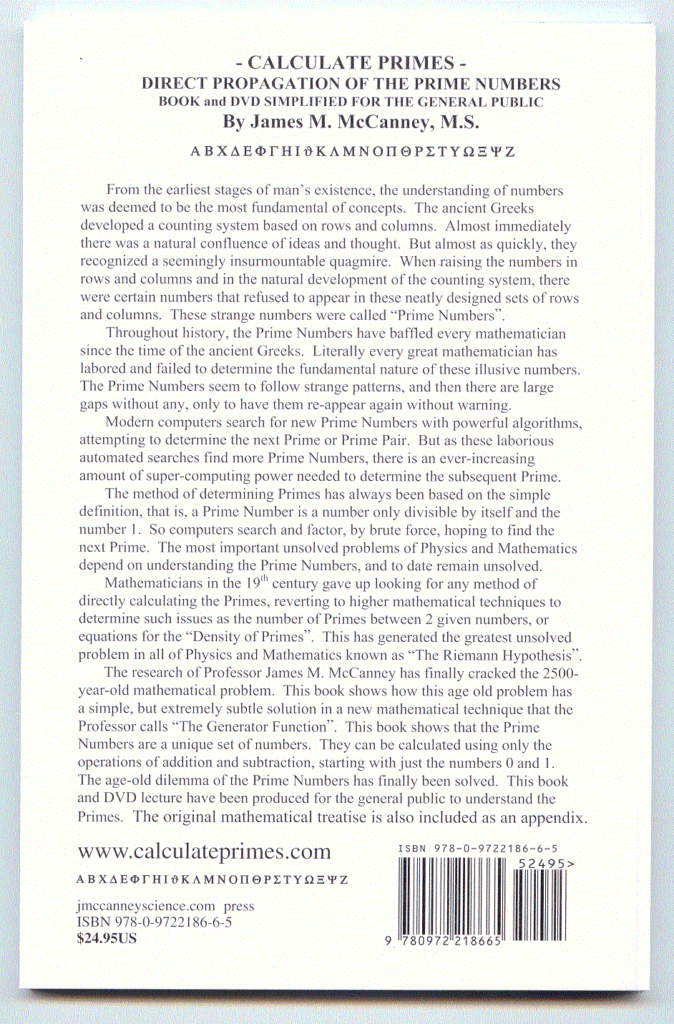
His search lead to a technique that is the basis for the discovery of the solution to the prime number problem presented in this book, and which now holds promise at solving some of the great mysteries of Quantum Physics as well as Genetics. It is based on the Mathematical Operators that the Professor calls “Generator Functions”.
These mathematical expressions operate on fundamental units or building blocks of nature such as the numbers 0 and 1 (as in the case of the prime number solution in this book) or atomic nuclei (in the case of quantum mechanics) or atoms and small molecules (in the construction of large organic molecules or genetic structures). According to Mr. McCanney, the Generator Function is an operator that reflects conditions in nature, it builds up a first layer when applied to the basic building blocks, and then is applied to this construct to form a second more complex structure. The same Generator Function is then reapplied to this result and the process continues, with each successive application modifying the prior set of results.
This leads to questions that are being asked for the first time. For example in genetics, could the makeup of the human biped be not only duplicated somewhere else in the universe, but is the norm rather than the exception based on “Generator Functions” that operate on the building blocks of life. Could this pattern be replicated on the far side of the universe just as a diamond would appear the same in such a distant place?
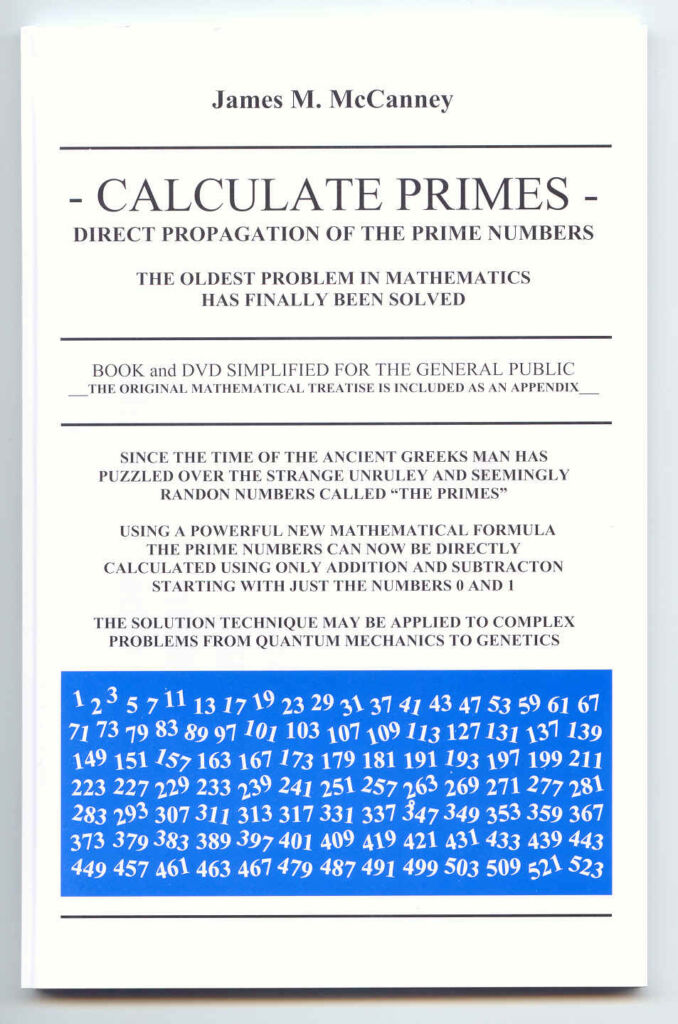
On a simpler note, as the prime numbers would be discovered by intelligent beings on the far side of the universe, they would follow the same mathematical Generator Function that we would discover here on earth. The implications of this new mathematical technique may someday very well overshadow this initial application and the discovery of the formula for directly calculating the prime numbers to infinity as presented in this book and DVD lecture (Appendix I contains the original mathematical treatise).
An essential aspect of the Generator Function concept is that it creates intermediate or false solutions that are necessary steps to generate the final correct solution. This is possibly but one of the reasons why so many mathematicians have worked around the prime number problem without finding a solution, as they failed to see the total picture as presented in this book. Countless mathematicians have come to the conclusion that that prime numbers are random with but passing patterns. This book proves that to be incorrect. When you finally look at the prime number table and see why every number is there and how it is related to all the other primes, with all of their “ancestors” bridging back to the numbers 0 and 1, you will understand the powerful impact this book will have on the future.
This is a brief but incomplete history of the background that makes The Professor, as many people call Mr. McCanney, a person with a unique background and qualifications.
Mr. McCanney airs a weekly radio show “The James McCanney Science Hour – At the Crossroads” heard world wide on short wave radio and also broadcast on the internet. He has been a popular regular guest on many national and international radio shows. Most people know of “The Professor” from his work regarding the electrical nature of outer space and its relation to our planet and human beings that inhabit our blue planet.
He has worked over his career on the current topic of the prime number solution and has taught the following mathematics courses at the University level (in addition to Physics, Computer Science and Astronomy); Abstract Algebra, Linear Algebra, Matrix Algebra, Probability and Statistics, Statistics for Computing, Mathematical Logic, Theory of Numbers, Calculus I, II and III, Engineering Math I and II, Advanced Topics in Geometry and Topology.
He has been an avid student of the history of both Physics and Mathematics and has studied the past to understand what is of greatest importance in the future of these fields of study. The present book is a glimpse into this rarely seen side of Professor McCanney. He has stated that his greatest discoveries to date include the cause of surface fusion on the sun, which gives rise to the solar electric field that drives the electrical nature of the solar system. His second great discovery, which was published almost 2 decades before its discovery, was the prediction that comets would produce x-rays far to the sunward side, as well as the electrical nature of comets and the prediction that comet nuclei would not contain water or ice, but would be hot dry asteroid type bodies (a prediction that has repeatedly been proven by subsequent space probes), much to the surprise of professional astronomers.
A third major theoretical discovery, which has been observed both in nature and subsequently measured in the laboratory, he calls “The Induced Electric Dipole Red Shift”. This is an effect on photons of light moving through a non-uniform electric field that causes both a red shift as well as a bending of light. It also explains the previously unknown cause of pair production (electron-positron production) in photons passing near heavy atomic nuclei. His theoretical work then restructures the laws of cosmology based on this new form of red shift.
And last but not least, his work has rediscovered the work of Tesla and further provides a theoretical basis for deriving unlimited electrical energy from the ionosphere. Another result of his decades of research has been the realization that severe earth weather including hurricanes and tornados are powered by electrical discharges from the ionosphere to the clouds in storm systems. The list of scientific discoveries also includes an electromagnetic propulsion system for use in space travel that has been field-tested.
In spite of these discoveries that were confirmed in many cases decades after Mr. McCanney’s theoretical predictions were published, he now has stated that the current treatise on prime numbers potentially may have the greatest significance in the history of both Physics and Mathematics. The solution of the Prime Number Problem has eluded every great mind since the Greeks first defined it nearly 2500 years ago. Cauchy, Gauss, Riemann, Euler, and countless others spent their entire lives scouring this problem, yet could not crack the fundamental problem of being able to directly calculate the prime numbers. Countless major unsolved problems in both Physics and Mathematics base their solutions on the prime numbers, yet no one could directly calculate these illusive and perplexing numbers, that is, until now.
It was in quest of this solution and the understanding of its importance that has brought us to herald this work, which is now explained in a way that only the good Professor can do, making it understandable by anyone with a rudimentary knowledge of mathematics. The solution is simple and elegant, the way nature intended.
At present there are two more books destined to become part of this series that will be released at later dates.